Showing posts with label HISTORY THAT MUST KNOWN. Show all posts

Friday, 29 January 2016

How Do Astronauts Scratch and Itch When In Their Space Suits?

International Space Station and astronaut in outer space over th

Without the use of their hands, astronauts have to rely on other means to scratch various itches. For any itch outside of the face, retired astronaut Clayton Anderson explained, “You shake, rattle and roll, baby!  That’s the only thing really that you can do to alleviate that itch. Hopefully, between the incredibly bulky and stiff suit itself and the liquid cooling garment you are wearing beneath the suit, you can wiggle your body enough to effectively scratch that itch!”
Itches on the face can be a bit more tricky, but there are things within reach. For instance, under the helmet astronauts wear what is sometimes referred to as a Snoopy Cap that is equipped with earphones and a microphone. If an itch presents itself on the lower half of the face, the microphone is one commonly used scratching post. The downfall of this method is that the action sometimes moves the microphone out of position, interfering a little with the sound quality in communications.
blowAnother option astronauts use is the valsalva device, which is a foam piece attached to the bottom interior of the spacesuit helmet. The purpose of the valsalva device is to allow an astronaut to block up their nostrils and blow to equalize pressure in the ears when necessary. Beyond its intended purpose, the foam block is a handy device for scratching an itch.
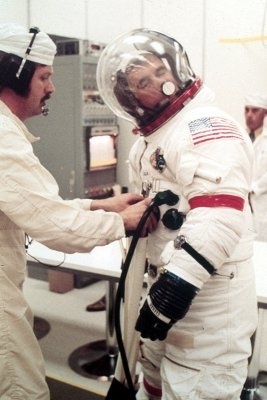
Of course, you could potentially get a little snot rubbed on the itchy spot if you’ve previously used the humps on the valsalva to stopper your nose, but desperate times and all that…
scratchingA third option to address facial itches is a strategically placed piece of Velcro. This was particularly used during the Apollo missions. (And, note, contrary to popular belief, Velcro was not invented by NASA, nor specifically for use in the space program.) The astronauts would typically place the Velcro on the little feed port flap that is held closed via the pressure in the suit when out in space. Apollo 17 astronaut Harrison Schmitt noted, “Everybody seemed to agree that you needed that [Velcro]…”
If an itch pops up where nothing sufficiently abrasive can be rubbed against it, the astronaut simply has to endure, generally using the distraction tactic until the itch fades. This is easier than in some other settings. A typical spacewalk lasts between five and eight hours and being out there working is incredibly laborious due to how stiff the space suit gets when in the near vacuum of space (even just flexing your fingers to grip things is relatively difficult). Between the straining and extreme focus needed to complete some of the tasks the astronauts are out there for, not to mention the absolutely beautiful view and the knowledge that there is very little between you and the near vacuum of space, there’s plenty to get caught up in and forget all about the itch.
If you liked this article, you might also enjoy:

Bonus Facts:

  • Beyond having to deal with itches that are sometimes impossible to scratch, astronauts out space walking also have to potentially deal with having to go to the bathroom. The solution here is simple- essentially, an adult diaper specially designed for maximum absorption. Now just think that those space suits are re-used by other astronauts…  One can imagine space walking flatulence also isn’t terribly pleasant.  (And if you’re curious, see: Why Other People’s Farts Smell Worse).
  • The term “astronaut” is derived from the Greek words astron, meaning “star,” and nautes, meaning “sailor” -so, essentially “star sailor”.
  • In the free-fall state astronauts orbiting the Earth find themselves in, sweat and tears do not flow downward and instead cling to surfaces and blob together. This can become a major vision problem when sweat and tears form bubbles in the eyes or on eye lashes.
  • Even worse is a potential coolant water leak during a space walk. This happened to astronaut Luca Parmitano, resulting in his space walk abruptly terminated as his helmet began to fill up with a giant glob of water.  Towards the end as he was waiting for the pressure to equalize on the hatch, with the water in the helmet continuing to increase, he was beginning to have trouble seeing, hearing, and even talking. The bigger concern, of course, was that he might accidentally suck up some of the glob of water as he was trying to breathe around it. This would have resulted in him coughing uncontrollable, only making the situation worse and potentially causing him to drown in the suit. As Flight Director David Korth said of the event, “You can imagine, you’re in a fishbowl… That’s not anything you take lightly.”  It was later discovered that one of the suit’s coolant line filters got clogged, causing water to leak out and into his helmet.  In total, the coolant system contains a little over a gallon of water and is essential to keep the astronaut from overheating in the suit.
  • Before an astronaut ventures into space, the interior of the face shield is treated with an anti-fogging chemical to ensure body heat and sweat don’t fog it up. However, in 2011 astronaut Andrew Feustel went out on a spacewalk and ended up getting a droplet of the anti-fogger solution in his eye. The substance caused major irritation and his eye started to burn and tear up. Without the ability to use his hands, he was forced to use the valsalva device to try and reduce the stinging and get the tears to stop clinging to his eye so he could see from it again.
  • Sneezing in space also presents problems and astronauts learn how to sneeze in the suits during training. Astronaut Dave Wold states that the trick is to have good aim– “Aim low, off the windshield, because it can mess up your view and there’s no way to clear it…”

What Happened to Huey, Dewey, and Louie’s Parents?

huey-dewey-louie

In 1934 Walt Disney introduced the world to Donald Duck, Mickey Mouse’s lovable ill-tempered friend. Donald was an instant success, becoming one of the most popular cartoon characters of all time. Three short years after his creation, comic artist Al Taliaferro got the idea to create three nephews for Donald: Huey, Dewey and Louie. In the trio’s comic debut on October 17, 1937, Donald received a letter from his cousin, Della, just before the boys arrived:
“Dear Donald:
I am sending your angel nephews Louie, Huey and Dewey, to stay with you while their father is in the hospital. A giant firecracker exploded under his chair. The little darlings are so playful. I hope you enjoy them.
Your cousin,
Della”
With open arms and a willing heart, Donald welcomed his nephews into his home. Of course, he soon realized that the “angels” and “little darlings” that Della referred to were rebellious, destructive monsters.
So what happened to their dad? As Della’s letter touched upon, their dear old dad was sent to the hospital after a firework exploded under his chair- a firework placed there by his own sons: Huey, Dewey, and Louie (or perhaps it was their phantom brother, Phooey!- the mysterious fourth nephew who appeared at random times in various comic panels).
This is the last we really hear about their dad. On one version of the Duck family tree, the triplets’ dad is nothing more than an obscured duck with no first name and a big question mark on his head. On other depictions of the family tree, their dad is seen as a nameless face beside his wife. His appearance on the Duck family tree is the only visual of Della’s husband.
Drawing from what little information is available, Daddy Duck either died in the hospital or abandoned his kids and fled as far away as possible to avoid any more of their high jinks.
So what about Huey, Dewey, and Louie’s mom? Dumbella Duck, aka Della, is a bit more complicated of a case. In her aforementioned letter, you may have noticed that it was signed, “Your cousin” not “Your sister.” She also explicitly states the three kids in question are Donald’s nephews. This would imply that Della was not their mother given she is Donald’s cousin here, unless the boys’ father was supposed to be Donald’s brother and we simply have a case of cousin marriage- not totally uncommon in this era (see: The Surprising Truth About Cousins and Marriage). Another possibility is that she is somehow Donald’s cousin and sister, but we’re not going to go there…
If the “Donald’s brother was their father” scenario isn’t correct, given that Della was seemingly caring for the children while their father was in the hospital, it would seem to indicate that their real mother was out of the picture at this point.
However, when a similar letter is read in the 1938 cartoon, Donald’s Nephews, the letter and story are modified slightly,
Dear Brother-
I am sending your angel nephews to visit you -Sister, Dumbella
To make things more confusing, when Carl Barks released his version of the Duck family tree in the 1950s, he refers to the triplets’ mom as Thelma Duck (perhaps going back to the original comic book story where Della was a cousin). On this line thinking, some fans have suggested that Dumbella, Della, and Thelma are different characters, while others argue that Della is just short for Dumbella. Since the name Thelma is never used in the comics or theatrical shorts, and her name changed back to Della Duck with Don Rosa’s 1993 revised version of the Duck family tree, Thelma seems to be null and void and simply a mistake in Barks’ work.
Given later story lines, it would appear the “Della and Dumbella are the same duck” theory is correct. For instance, in the comic book series, The Life and Times of Scrooge McDuck, written in the mid-1990s, Donald and Della were shown wearing identical sailor outfits as kids and depicted not only as siblings, but as twins.
Thus, it would seem that when Della was originally introduced as Donald’s cousin, her character (and the boys’ backstory) was not given much of any thought as Huey, Dewey, and Louie at this point were only supposed to be around for a short visit- just a convenient plot device for an issue of the comic.  However, when they put the boys in the cartoon, they decided to explain where the characters came from in a way that made a little more sense; so Donald ended with a sister, instead of a cousin, sending him his nephews.
This brings us back to what happened to Della Duck.  It turns out that in the Donald Duck comics and cartoons, aside from the aforementioned letter, neither parent was ever heard from again. So did they die or just abandon Huey, Dewey, and Louie?
According to the Duck family tree, Della and Donald are equal in terms of their familial relationship with Scrooge McDuck, yet Donald is always the one referred to as Scrooge’s closest living relative. This strongly suggests that she died, perhaps along with her husband. Or, as others have speculated, they simply faked their deaths and went into hiding to avoid having to take back their children. (Donald himself would later abandon the children for a while, leaving them in the care of their great uncle Scrooge while he went off and joined the navy.)
That said, while Scrooge’s frequent assertions about Donald seem to indicate Della was a dead duck, in the comic strip, Amen!, the triplets are depicted saying prayers for their mom and dad, which may indicate that they are still alive and well…somewhere. Or maybe no one bothered to tell them their parents had died.
Whatever the case, in the 1942 cartoon, The New Spirit, it stated that Donald had officially adopted the triplets. As mentioned, the parents were never heard from again.
If you liked this article, you might also enjoy:

Bonus Facts:

  • Donald Fauntleroy Duck was first thought up after Walt Disney overheard Clarence Nash doing his now famous duck voice. Disney decided to hire Nash to do the voice of a duck character that would take over the role of some of the negative attributes that Mickey used to portray, but now with Mickey being a role model, could no longer do. Donald made his debut in The Wise Little Hen where he and Peter Pig tried various means to get out of doing work, such as faking stomach aches. Nash continued to do the voice of Donald for nearly a half century until he died of leukemia in 1985.  Other voices done by Nash included: Daisy Duck; Huey, Dewey, and Louie; and the bullfrog in Bambi.
  • Like any set of identical triplets, Huey, Dewey, and Louie are difficult to tell apart. Originally they were created as “one” character split into three, as was evident by the way they flawlessly finished each other’s sentences, as if they were operating off the same brain. Only when they appeared in DuckTales, and then later, Quack Pack, did they really start to exhibit individual characteristics. The only way to tell them apart was by the colors of shirts and hats they wore. However, prior to the 1980s, when they weren’t dressed identically, colors for each nephew were chosen at random and rarely consistent. Once they established signature colors for each brother, Huey was dressed in red, Dewey in blue, and Louie in green. Dave Smith, Disney’s archivist said, “Note that the brightest hue of the three is red (Huey), the color of water, dew, is blue (Dewey), and that leaves Louie, and leaves are green.” This is not to say the triplets didn’t switch it up every once in awhile or appear in colors deviating from their “signature” color.  Not that it would have mattered to Donald necessarily. In the wartime short, Donald Gets Drafted, Donald Duck is shown to be colorblind, though it isn’t clear what type of colorblindness he suffers from.
  • As if the triplet’s identities aren’t complicated enough, enter Phooey. Phooey is Donald’s phantom fourth nephew who has appeared in at least seven comic book panels over the years as a result of artistic errors not caught in time prior to publication.
  • Huey, Dewey, and Louie joined the scouting organization, Junior Woodchucks, when they were 11 years old. Their involvement in this group is often attributed to bringing about the change in their behavior, going from rebellious monsters to fairly respectable individuals interested in helping their Uncles Donald and Scrooge in their adventures.
  • Huey and Dewey were named after two political figures, Huey Long of Louisiana, and Admiral George Dewey of the Spanish-American War. Louis was named after Louie Schmitt, one of Disney’s animators. Their full names are Huebert, Deuteronomy, and Louis.

Why There Is No E in the A-F Grading Scale

grades

Some schools do hand out E letter grades instead of an F, but they are in the minority. A majority of schools in the United States, particularly beyond primary age, give grades of A, B, C, D, or F.
Rather than a failure on the part of academic institutions to know the alphabet, the simple answer is that “F” stands for “fail.” The other four grades are more or less considered “passing” (though in some districts a D is also a failing grade), which is why they go in alphabetical order. The F is considered separate as it denotes a failing grade, and does not need to go in alphabetical order. It just so happens that “fail” starts with a letter that skips one letter alphabetically on the scale.
That said, E was used at one point. The first college in the United States to use a grading scale similar to the one we know today was Mount Holyoke College, an all-women’s university in Massachusetts.
Before that, Yale used a ranking system in 1785 where “optimi” was the highest mark, followed by second optimi, inferiore (“lower”), and pejores (“worse”). William and Mary ranked students by number, where No. 1 was the first in their class and No. 2 students were “orderly, correct and attentive.”
For a while, Harvard had a numerical grading system where students were graded on a scale from 1-200 (except for math and philosophy classes, which were 1-100). Yale had a four-point scale in 1813, switched to a nine-point scale somewhere down the track, and back to a four-point scale in 1832.
In 1883, there’s a single reference to a student earning a “B” at Harvard, but historians haven’t found additional documentation to back up the idea that a letter grade system was actually in place at that point. It is known that just a few years later, Harvard had a system of Classes in place—students were either Class I, II, III, IV, or V, with V being failing.
That brings us back to the 1887 Mount Holyoke system, which looked something like this:
  • A: excellent, 95-100%
  • B: good, 85-94%
  • C: fair, 76-84%
  • D: barely passed, 75%
  • E: failed, below 75%
A year later, Mount Holyoke modified their grading scale. “B” became anything from 90-94%, “C” was 85-89%, “D” was 80-84%, and “E” was 75-79%. Below that, they added in the dreaded “F.”
Over the years, the letter grading scale became popular across colleges and high schools alike. A lot of schools skipped E and went straight to F. Apparently, some teachers were concerned that students and parents thought E stood for “excellent,” though there is no evidence suggesting that they thought A stood for “awful,” so it’s possible that schools were just trying to simplify the scale. After World War II, some schools—many in the Midwest—decided to go back to E, getting rid of F.
In truth, any letter could stand in for E or F and still mean the same thing. Some schools use “U” for “unsatisfactory” or N for “no credit.” Educators could use just about any letter and it would amount to the same thing. It is simply an indicator of a non-passing grade.
The grading scale itself has been marked with an F (or E, or U, or N) by some people who believe it is no longer a relevant way to judge students’ work. For one thing, there are variations across institutions. Some schools use + and -; some don’t. Some say an A is 90% and up, or 93% and up, or 95% and up. Some consider a D to be a failing grade rather than a passing one.
Critics of the grading scale believe a written analysis of students’ work would be more effective in terms of feedback, but they recognize that students and parents probably wouldn’t read them and teachers, who are often overworked as it is, don’t have time to write them anyway. Letter grades are just an easy way to generalize a student’s performance; so despite the discrepancies between schools, they’ll probably be around for a long time.
If you liked this article, you might also enjoy:

Bonus Facts:

  • Finland had one of the highest-ranked education system in the world for many years, but they lost out in 2013 to Japan.  The UK rang in at #3 in 2013; Canada #7; and the United States #18, out of 200 countries considered.  Surprisingly, Japan only spends and average of $10,596 per student and Finland just $10,157.  In contrast, the U.S. spends $15,172 per student, the highest of any country.  That’s about 2.5 times more per student than the #17 ranked Estonia, which is one ahead of the United States.
  • According to the National Center for Education and Statistics, around 50.1 million children were attending U.S. public schools; 5.2 million were in private schools; over 1.5 million were homeschooled; and 21.8 million people were attending university.
  • With record numbers of students attending university, around 2 million high school students took 3.7 million Advanced Placement exams in 2012, trying to earn college credit. Advance Placement exams are graded on a 1-5 scale, with 5 being the best. The minimum score to earn college credit is a 3, with many universities requiring a 4 or 5 on individual exams. When taking an AP exam, correct answers obviously count toward your score, but wrong answers will knock points off your score, while answers left blank do nothing.
  • Two major standardized tests that U.S. high school students take in order to get into college are the ACT and SAT. Colleges usually accept one or the other. The first is scored out of 36, while the latter is scored out of 2400. In some states, these standardized tests have been integrated into state standardized testing.
  • In the UK, the dreaded E grade is much more common than the F. Again, they both mean you probably should have studied more, so there isn’t much difference between them except for preference.
  • 14% of adults in the U.S. are illiterate, according to the National Assessment of Adult Literacy. A further 29% demonstrated only a “basic” reading level.

Why Neil Armstrong Got to Be the First to Step on the Moon

moon-landing

On July 20th, 1969, with “one small step,” Neil Armstrong became the first person to walk on the moon. Since that date forty five years ago, the moon landing has been the subject of intense study and historical analysis. From what Armstrong actually said with his first step to if the American flags the astronauts planted are still there, mankind’s first rendezvous with the moon has captured the world’s attention in a way few other things have. Despite this, there are still several noteworthy facts that have remained obscure after all these years. Allow us to bring just a few to (moon) light:
Neil Armstrong was chosen to be the first person on the moon due to the basic structural design of a part of the Eagle.
Out of a group of 29 astronauts that trained for the Apollo mission to the moon, only three were chosen when the final announcement was made in January of 1969. Neil Armstrong, Edwin “Buzz” Aldrin, and the oft forgotten Michael Collins became the official crew of Apollo 11. Immediately, attention turned to which crew member – Armstrong or Aldrin — would be the first to walk on the moon (Collins was the command module pilot and, therefore, was ineligible).
Even though both men were going to walk on the moon, it was a great honor to be the first. In fact, the question was asked at the press conference and the response was that it had yet to be decided.
Over the next four months, as the astronauts continued their training, debate and rumors circulated among the media. At first, it seemed that Aldrin would have the honor. This speculation came from the precedent set by the Gemini program, which made ten crewed flights for the purpose of testing ships and astronauts to spacewalk. During the flights, the commander (which Armstrong was to be for Apollo 11) stayed inside the ship while the pilot (which Aldrin was to be for Apollo 11) did the space walking. Further fueling this thinking was that it was rumored that Aldrin was actively campaigning to be the guy. According to the memoir written by Chris Kraft, head of Mission Control, “Buzz Aldrin desperately wanted that honor and wasn’t quiet in letting it be known.”
In April, only three months before liftoff, it was announced that Neil Armstrong would be the first man to walk on the moon. The main reason NASA gave for the decision was that the Eagle’s hatch opened to one side – rather than up or down – and that side was towards the pilot, Aldrin. The bottom line was that when the hatch was opened, the commander, Armstrong, had a clear path to exit, while the pilot was pinned in the rather cramped space of the module. By a sheer happenstance, it made more sense for Armstrong to exit first. Plus, as NASA’s heads pointed out, Armstrong was actually the more senior member of the team anyway, having entered the program in 1962, while Aldrin came in 1963.
In later years, despite the official hatch story, some, including Kraft and fellow astronaut Al Bean of have come out and said that NASA wanted Armstrong to have this honor rather than Aldrin because they thought Neil’s ego could handle it better than Aldrin’s. So perhaps the hatch design simply gave them the excuse they needed.
Armstrong’s famed “one small step” line was pre-planned, at least according to his brother.
Even until his last breath in 2012, Armstrong adamantly insisted that his first line was spontaneous and was only settled on in the moments prior to the walk. A BBC documentary released after the astronaut’s death disputes that. In the film, Dean Armstrong – Neil’s brother – tells the story of a note passed during a late-night game of Risk (yes, the board game).
In the months leading up to the mission, Dean, Neil, and their families spent time together on Cape Cod. After both men put their boys to bed, Neil challenged his younger brother to a hearty game of Risk. During that game, Neil handed Dean a piece of paper:
“On that piece of paper there was ‘That’s one small step for [a] man, one giant leap for mankind.’ ‘He says, ‘What do you think about that?’ I said ‘fabulous.’ He said, ‘I thought you might like that, but I wanted you to read it.”
That said, both Aldrin and Collins made it clear that at no point did Armstrong share his thoughts about what he would say. Of course, perhaps his brother was an exception.
The second thing said on the moon was a tad less poetic than the first.
While everyone remembers that first line, few can recall the second. That’s because it didn’t hold the same “oomph” factor. According to the official Apollo 11 Air to Ground Voice Transcription, that line was “And the – the surface is fine and powdery.”
Armstrong continued on this line of thinking,
“I can – I can pick it up loosely with my toe. It does adhere in fine layers like powdered charcoal to the sole and sides of my boots. I only go in a small fraction of an inch, maybe an eighth of an inch, but I can see the footprints of my boots and the treads in the fine, sandy particles.”
After further discussion about the ease of movement on the moon, they began to go back and forth about Buzz’s placement of the camera and backlighting. Exciting conversation, indeed!
President Nixon had an “In Event of Moon Disaster” speech ready
After the Apollo 1’s tragic fire in 1967 and the unproven nature of space travel at the time, the safe return of Apollo 11’s crew was far from an assured thing. To that point, President Nixon had to prepare for every scenario when he addressed the nation, including the tragedy of a “moon disaster.” So, he had his speechwriter, William Safire, prepare remarks that are both chilling and inspiring. The speech begins with these two lines,
“Fate has ordained that the men who went to the moon to explore in peace will stay on the moon to rest in peace. These brave men, Neil Armstrong and Edwin Aldrin, know that there is no hope for their recovery. But they also know that there is hope for mankind in their sacrifice.”
Additionally, below the “death” speech were instructions to what needed to be done both before and after the address to the nation. Before, the President should “telephone each of the widows-to-be.” Afterwards, NASA will end “communications with the men” and “a clergyman should adopt the same procedure as burial at sea, commending their souls to the ‘deepest of the deep,’ concluding with the Lord’s Prayer.”
If you liked this article, you might also enjoy:

Bonus Fact:

  • Buzz Aldrin’s mother’s name, before getting married, was Marion Moon.

The Men Who Dropped the Bombs on Hiroshima and Nagasaki

paul-tibbets

At 2:45 a.m. on Monday, August 6, 1945, a propeller-driven, four-engine Boeing B-29 Superfortress aircraft lifted off from the unassuming island of Tinian, its destination due North. Inside, as was customary for the B-29, was a bomb. However, unlike the bombs with which the US Air Force had scorched Japan for roughly a year, this bomb was not filled with the usual incendiaries. Rather than isobutyl methacrylate or its more famous kin, Napalm, this bomb was packed with two masses of highly enriched uranium-235. The bomb, named “Little Boy”, was anything but: snout-nosed and weighing in at 9,700 pounds, it resembled nothing more than an obese metal baseball bat. At 8:15 a.m. local time, poised above Hiroshima’s Aioi Bridge, Little Boy dropped.
44.4 seconds later it detonated. 60,000 people died instantly. 31,000 feet above, and 10 and a half miles away from them, Paul W. Tibbets, en route to Guam, felt a 2.5g shockwave driven before a kaleidoscopic pillar of smoke and debris. He felt no regrets.
Brigadier General Paul W. Tibbets, pilot of the Enola Gay, dropper of Little Boy, recipient of the Distinguished Service Cross, Legion of Merit, Distinguished Flying Cross, Purple Heart and four Air Medals, was born February 23, 1915. The young Tibbets performed his first flight at the age of 12, dispensing candy bars to a crowd at the Hialeah, Florida racetrack. Bitten by the flying bug, Tibbets, in February 1937 enlisted in the army. His flight instruction performance at Randolph Field, San Antonio, Texas showed him to be an above-average pilot.
Upon graduating as a second lieutenant, Tibbets first stint was as personal pilot to George S. Patton, allowing him to rack up over 15,000 hours of flight time. Tibbets ascended rapidly through the ranks, becoming a captain with his first command by 1942. In 1942, Tibbets ran the gauntlet at Lille, flying lead in a 100-plane raid with a 1/3 casualty rate. Despite the seemingly heavy losses, this was seen as a qualified success, proving that US Air forces would not break under stubborn opposition. Promoted to lieutenant colonel by November 1942, Tibbet’s cut his teeth further during the war in Northern Africa, flying Eisenhower to Gibraltar for Operation Torch, the Allied invasion of French North Africa.
By 1943, Tibbets had earned himself as reputation as a seasoned and senior pilot, one vouched for by Eisenhower himself. After testing the newly-minted Boeing B-29 for a year, Tibbets was recommended to Major General Uzal Ent for consideration, for a “special mission”. In September 1944, Tibbets became responsible for the organization, training and command of a secret unit, Silverplate, the Air Force wing of the Manhattan Project. Tibbets was tasked with ironing out the logistical and technical kinks: requesting modifications to bomb bay doors, in order to accommodate the bulky weapon, organizing crews with photography and scientific equipment, to record the event for posterity and finally, deciding that he himself would drop the atomic bomb.
Upon receiving orders targeting the cities of Hiroshima, Kokura and Nagasaki, as the primary, secondary and tertiary targets of the nuclear strike, Tibbets readied his crew. At 2:15 am, they were airborne. The rest is history. Tibbets, recollecting the sight of the boiling cloud in his memoirs, wrote, “If Dante had been with us in the plane he would have been terrified!”
Charles Sweeney
Charles Sweeney
Three days later, Major General Charles Sweeney dropped the bomb on Nagasaki. Sweeney was well prepared, flying five rehearsal test drops as well as co-piloting the support and observation aircraft for the Hiroshima bombing. Nonetheless, Sweeney’s flight performance on August 9th had none of the aplomb that Tibbets had displayed. First, the night before, Sweeney’s B-29, named Bockscar, had malfunctioned, with the reserve fuel bladder failing to pump. Running on 600 gallons less of fuel than expected, Sweeney nonetheless decided to go, intending to rendezvous with his two escort aircraft at 30,000 feet near the island of Yakushima, a fuel intensive task at that height.
Due to confusion at the rendezvous, for which Sweeney would be reprimanded later, valuable time was lost. The crew finally reached Kokura only to find it partially obscured, which was problematic given the clear directives to conduct a visual, rather than radar, bombing. After two unsuccessful flyovers, and running low on fuel, Sweeney opted for his second target: Nagasaki. Sweeney’s bad luck was Kokura’s good – indeed, so much so that the phrase “Kokura luck” has entered into the Japanese lexicon. With desperately little fuel left, and heavy cloud cover over Nagasaki, Sweeney decided drop Fat Man by radar, despite his orders to the contrary. The resulting 1.5-mile inaccuracy spared Nagasaki a great deal of damage, with the surrounding hills intercepting much of the blast. With only 60 percent of Nagasaki destroyed and two engines kaput from fuel exhaustion, Sweeney made a rough landing in Okinawa, with just seven gallons of fuel remaining. To say Tibbets was unamused by Sweeney’s near-failure, would be an understatement. However, the close-shave success was sufficient to ensure that no action would be taken against Sweeney.
Post Nagasaki, both men have been unshakeable in defending the dropping of the bombs as right and proper. Tibbets remains “convinced that we saved more lives than we took,” and concludes, “It would have been morally wrong if we’d have had that weapon and not used it and let a million more people die.” Sweeney, in his memoirs, made similar assertions, but drew fire for factual inaccuracies in his account of events. Indeed, so indignant was Tibbets at Sweeney’s account, Tibbets added a chapter to his own memoirs, in which he vented his displeasure at Sweeney’s command of the bombing.
Sweeney died at age 84 on July 16, 2004 at Massachusetts General Hospital in Boston. Tibbets died at age 92 in 2007, in his Columbus Ohio home.
If you liked this article, you might also enjoy:

Bonus Facts:

  • Paul Tibbets claims in his memoirs that the code name “Fat Man” referred to Winston Churchill, but Robert Serber who worked on the design project and actually named the bombs, claims in his memoirs that it was named after Kasper Gutman, “The Fat Man”,  in the film The Maltese Falcon.  Although, Serber also has been recorded to have said the names simply came from the size and shapes of the bombs.
  • Only one person, Lt. Jacob Beser, flew aboard the aircraft on both the Hiroshima and the Nagasaki atomic missions.

Real Life Maelstroms

whirlpool

Where a unique combination of strong currents and geography meet, maelstroms, enormous and powerful areas of swirling water, dangerous currents and whirlpools, can be found across the globe. Although many form (and die) in a relatively short period of time in response to catastrophic events (like a tsunami), others have existed for centuries.

Asia

Naruto

Found in the strait between Naruto (in the Tokusima Prefecture on Shikoku Island) and Awaji Island, the Naruto whirlpools reside in the strait of the same name. As the strait connects large inland seas with the Pacific Ocean, the significant tide moves from anywhere from 8 MPH up to 12 MPH twice daily, producing a strong current. In fact, the super-speedy Naruto current is considered one of the fastest in the world and can pose a hazard to unwary ships.

Europe

Corryvreckan

Meaning the “cauldron of the plaid,” Scotland’s Corryvreckan is the world’s third largest maelstrom. Found off the country’s west coast, this maelstrom is formed when 10 MPH tides flood a narrow strait between two islands and butt against a deep hole and tall pinnacle. A collection of standing waves (some 30 feet high) and whirlpools are created and together they produce a roar that is audible 10 miles away.
According to Scottish myth, the maelstrom is formed when the goddess of winter uses the waters to wash her plaid clothes (which turn white when clean to become the region’s seasonal blanket of snow).
To study this beast, documentary makers put a life jacket and a depth meter on a mannequin in 2006 and threw her into the maelstrom. When she was finally found, she showed evidence of being dragged along the bottom, at a depth of 262 feet.

Garofalo

Otherwise known to the world as Charybdis, the whirlpool that sucked in Odysseus’ boat, Garofalo is found in the strait between Italy’s mainland and Sicily. Not technically a whirlpool, Garofalo occurs when the winds and tides meet at cross-purposes in the less than two-mile wide (but over 800 feet deep) Strait of Messina. The rough seas produced are known to be very hazardous for small vessels, and occasionally, even dangerous for large ships.

Moskstraumen

Perhaps the most famous of the maelstroms, and the monster that inspired the name, Moskstraumen’s might inspired both Jules Verne and Edgar Allan Poe when they wrote of fearful and deadly whirlpools. Located off of Norway’s northern coast, Moskstraumen, unlike its brothers that occur in rivers and straits, is found in the open sea.
To form Moskstraumen, strong currents combine with semi-diurnal tides (two high-tides and low-tides each day) and powerful winds where deep and shallow water meet between two islands to create a collection of eddies and whirlpools to catch the unwary. With its largest whirlpool about 130-160 feet across and currents that can exceed 17 MPH, some claim Moskstraumen is the most destructive of all the maelstroms.

Saltstraumen

Abutting Norway’s mainland, nestled in one of its many fjords, lies the strongest maelstrom in the world, Saltstraumen. With tidal currents that reach speeds of 25 MPH, Saltstraumen boasts whirlpools that are 33 feet across and 16 feet deep, and has been around for at least two thousand years.
Created when the tide enters the Skjerstadfjorden, the Saltstraumen renders its strait impassable, although fishermen enjoy its plethora of cod, halibut and coalfish (the strong currents suck in the microscopic life at the bottom of the ocean food chain, ultimately drawing in the larger fish). Later, when the tide turns and the water rushes out, the strait becomes navigable.

North America

Niagara Falls

Over four thousand years old, the Niagara whirlpool is formed downstream from the falls, as the fast-moving current (at 20 MPH) rushes out of the Niagara Gorge and meets an ancient underwater depression. This latter, called Saint David’s Buried Gorge, sits nearly cross-wise with the Niagara River and when they meet, a maelstrom is formed that usually produces a counter-clockwise whirlpool, although when significant water is diverted upstream, the circular current reverses.

Old Sow 

Situated in the Bay of Fundy, in the Western Passage of Passamaquoddy Bay in between New Brunswick, Canada and Eastport, Maine, Old Sow may be perhaps the most unpredictable of the maelstroms. Depending on her mood, she presents eddies (called piglets), spouts, holes, troughs, fast currents, and the occasional whirlpool. At one point, one of her vortices was recorded along the southern end of Deer Island with a diameter of 250 feet.
As with other maelstroms, under the ocean’s surface, tidal waters travel up a deep trench (about 400 feet), meet an underwater peak (here, at about 119 feet) and dive again to about 350 feet. The strong ocean tide meets with currents coming in from other straits, creating this fickle leviathan.
Her unique name is attributed to two distinct sources: (a) the Old Sow makes sounds that sometimes mimic the grunts of a pig; or (b) it reflects a misunderstanding of the world “sough” which refers to a drain or a sucking noise.
If you liked this article, you might also enjoy:

Bonus Fact:

  • Ephemeral whirlpools formed in the waters of Japan after the massive earthquake and tsunami that hit the island nation in 2011. As with the permanent maelstroms, the large rush of water suddenly meeting certain geographic features produced the whirlpools. In this case, however, most of these vortices formed after the massive amounts of water that had moved inland with the wave suddenly receded. The large whirlpools that were created sucked in at least one boat. It isn’t known if anyone was aboard.

The Origin of the Bigfoot Legend

bigfoot

Stories of a giant, hairy creature that appears half man and half ape have existed in various parts of the world for many centuries. In fact, the only continent not to have stories of “wild men” is Antarctica. In the Himalayas, it’s the Yeti. In Canada, it’s the Sasquatch. And in the northwest United States, it’s Bigfoot. Bigfoot is described by believers as being between six and eight feet tall with a large forehead and pronounced brow, like a cave man’s, and a rounded, crested head like a gorilla’s. He is covered in brown or red hair and has enormous feet that are his namesake, with the biggest estimation at a whopping two feet long by eight inches wide. Some “witnesses” claim that the five-toed Bigfoot prints they saw on the ground were accompanied by claw marks (not unlike a five-toed, clawed paw print of a bear—but rational explanations aren’t as fun).
Stories of a “wild man” existed among the Native Americans of the Pacific Northwest long before white colonists moved in. Versions of Bigfoot ranged from harmless giants who stole fish from fishermen’s nets, to cannibalistic monsters living on mountain peaks. These stories varied from tribe to tribe, and even from family to family, which meant that Bigfoot had a lot of different names. In the 1920s, J.W. Burns compiled the local legends for a series for a Canadian newspaper, coining the term “Sasquatch” in the process.
It wasn’t until 1958 that the Bigfoot legend really started to kick off in the United States. That year, a man named Gerald Crew found a set of large footprints at a construction site where he worked in California. He had his friend make plaster casts of the prints. The story gained a lot of attention after being published in the Humboldt Times, and was picked up by the Associated Press, drawing international attention.
Turns out, the footprints were a hoax (surprise, surprise). After the death of a man named Ray Wallace—the brother of the man in charge of the construction site where the prints were found—his family stepped forward to say that he was responsible for faking the prints. Scoop Beal, the editor of the Humboldt Times, is also said to have been involved. Nevertheless, the 1958 prints find brought the first “Bigfoot Hunters” to the area.
In 1967, the “Patterson-Gimlin film” was captured. The film shows a tall, hairy “Bigfoot” walking through the forest. Believers in Big Foot note the creature’s inhuman way of walking is a major point toward the film being real. Patterson also claimed to have taken the film to a group of people working in the special effects department at Universal Studios who supposedly said,
We could try (faking it), but we would have to create a completely new system of artificial muscles and find an actor who could be trained to walk like that. It might be done, but we would have to say that it would be almost impossible.
However, a number of factors lead to skeptics believing it’s a hoax: people who knew Patterson have described him, frankly, as a liar; Patterson’s version of events—including an estimate of how tall “Bigfoot” was— also changed and escalated over time.  More to the point, a man named Bob Heironimus claimed to have worn the Bigfoot costume for the making of the film. Most likely, and not too surprisingly, the film was a hoax.
The most common explanation for Bigfoot sightings is that people are playing pranks. There was even once a thriving market for “Bigfoot feet” to create your own prints to trick your family and friends. People still even dress up in ape costumes and ghillie suits in order to perpetuate the legend.
Some sightings are also simply misidentified animals. In 2007, a photo was snapped in Pennsylvania using an automatically triggered camera hanging from a tree. While believers claimed the blurry photo—showing a large, hairy creature standing on all-fours—was that of a “juvenile sasquatch,” the Pennsylvania Game Commission said the creature was most likely “a bear with an extreme case of mange.”  Looking at the picture, it could also just as easily been a human in a suit.
One of the big questions posed to believers in Bigfoot is if there are enough of the creatures to maintain a stable breeding population, and over a reasonably large area given all the supposed sightings—which there must be, unless they have extraordinarily lengthy lives—then why has a body of Bigfoot never been found? In 2008, Rick Dyer and Matthew Whitton claimed to have solved this problem after they supposedly found a Bigfoot body, posting a video of it on YouTube. The body was nearly eight feet tall and weighed over 500 pounds. Despite even some Bigfoot experts doubting the young men’s story, the discovery was covered by CNN, ABC, Fox, and BBC News, and the pair received $50,000 from Searching for Bigfoot, Inc. as “a measure of good faith.” However, when the body arrived in a block of ice and was thawed and examined, researchers found that the “body” was made up of rubber feet, fake hair, and a hollow head. Not exactly convincing. Dyer and Whitton later admitted that it was a hoax. (shocker)
While the idea of a real Bigfoot is pretty unconvincing, the stories have caught on and are so prevalent in pop culture that it’s unlikely the idea of Bigfoot will fade away any time soon. As with everything, treat the stories and information you hear or read with a healthy dash of skepticism. Someday real, solid proof of Bigfoot might emerge, but I’m not holding my breath.
If you liked this article, you might also enjoy:

Bonus Facts:

  • The term “sasquatch” comes from the Halkomelem word “sasq’ets” which is just a name for “wild men”, essentially referring to bigfoot-like creatures.   Halkomelem was a language spoken by a small group of Native Americans on the border between British Columbia and Washington.
  • While most scientists believe that Bigfoot is a legend, or a combination of hoaxes and misidentification, a few scientists—including Jane Goodall—have shown some amount of belief that such a creature could exist.
  • Nearly one third of all Bigfoot sightings are in the Pacific Northwest of the United States, with the rest of the sights spread out across the remainder of the states.

The Many U.S. Presidents Before George Washington

Schools in the United States teach children from an early age that the first president of the United States was George Washington. But teachers often forget to mention a small, kind of important detail- George Washington was the first U.S. president under the current United States Constitution, but he wasn’t the country’s first president.
Before the U.S. Constitution came into being, the Articles of Confederation served as the glue which held all thirteen states together as a single country. (See: The Articles of Confederation: The Constitution Before the Constitution) The Articles went into effect in 1781, and they established a loose alliance among the states. The Articles also defined the role of Congress to oversee the national needs, as well as the office of the president.
Due to the fear of giving too much power to one person, the office of president was extremely limited in power and scope, and was not even a paid position.  Rather, the primary roles of the president at this time were simply to preside over meetings and handle various state correspondence. The president was also the one who signed official congressional documents.
So who were these individuals who served such a lackluster position as the office of president?
John_HansonThe first president of the United States under the Articles of Confederation was John Hanson from Maryland. His term began in 1781 and ended in 1782. He at first attempted to resign directly after being elected (with so little power given to the office and no pay to boot, few wanted the position over political offices in their home states). However, ultimately a quorum could not be reached to name a successor, so he decided to stay on as president. Being the country’s first full-term president under the Articles of Confederation meant that he oversaw programs that helped to establish daily life in the new country. For instance, Hanson held the position of president when the government started on the road to creating what would become the U.S. Post Office and the National Bank. The government also established a single, uniform currency throughout the states under his mostly powerless watch.
Elias_BoudinotElias Boudinot of New Jersey became the second president, serving from 1782 until 1783. His presidency coincided with the official end to the American Revolutionary War. Boudinot presided over the country when the Treaty of Paris was signed in Paris on September 3, 1783. However, the Treaty of Paris did more than simply end the war; it required that the United States be recognized as an independent country and no longer a part of the British Empire. Besides being president, Boudinot was also noteworthy for his era for advocating for the rights of both Native Americans and black people, as well as directly sponsoring various youth among these groups so that they could receive an education.
Thomas_MifflinThomas Mifflin became the president for the term of 1783 until 1784. He oversaw the ratification of the Treaty of Paris during his presidency. Originally from Pennsylvania, he served under General George Washington during the Revolutionary War. That former position, and Washington’s later significance as the first president under the U.S. Constitution, made it somewhat ironic that president Mifflin accepted George Washington’s resignation as Commander in Chief.
Richard-Henry-LeeRichard Henry Lee of Virginia served as the country’s fourth president from 1784 until 1785. His presidency might have been pretty uneventful, but his political career afterwards was not. He became a vocal opponent of the now current U.S. Constitution out of the fear that it would create a centralized government too similar to the government that the colonies lived under as British citizens. He also hesitated because the document lacked a Bill of Rights, though many of his later suggestions were incorporated into the United States Bill of Rights.
John-HancockJohn Hancock, most famous for his large signature on the Declaration of Independence, held the position of the president from 1785 to 1786. His life in politics began long before the presidency, and he even helped to fund the American effort during the Revolutionary War. His life in politics continued after his tenure as president under the Articles of Confederation. He was reelected as Governor of Massachusetts—a position he resigned due to health before becoming president—and even ran against George Washington in the first U.S. presidential election under the Constitution. He did not expect to win, but had hoped to finish second so that he could become vice president. Ultimately that post went to John Adams.
Nathaniel_GorhamNathaniel Gorham, also from Massachusetts, served as the president under the Articles of Confederation from 1786 until 1787. Like many other presidents during the time, his presidency was simply another item on his long list of political accomplishments. He began his career as a public notary who quickly won election to the colonial legislature during the Revolutionary War. He served as a member of the legislature, became a judge even though he lacked legal training, and even attended the Constitutional Convention where he supported the new U.S. Constitution.  As for Gorham’s family, his sister was the wife of John Leighton, an ancestor of the second wife of Theodore Roosevelt, Edith Kermit Carow Roosevelt.
Arthur-St.-ClaireThe seventh president of the United States was a man from Ohio named Arthur St. Clair. He held the position between 1787 and 1788. He left Congress after finishing his term. He then received the appointment to governor of the Northwest Territory, a position where he often faced off with the Native Americans who claimed they, in fact, owned the land. Despite once being enormously wealthy, St. Clair ultimately died poor, with much of his wealth used to support the American Revolution and young government. Late in life, he gave away the little money that remained of his once vast fortune.
Cyrus-GriffinCyrus Griffin of Virginia had a background in law before he became the eighth and final president of the United States under the Articles of Confederation. He helped to put the country’s new judicial system on the path to becoming what we know today as the modern American court system during his work at the Court of Appeals in Cases of Capture. He continued to contribute to the new country’s court system after his presidency when he went on to become a judge with the District Court of Virginia.
If you liked this article, you might also enjoy:

Bonus Facts:

  • There were also presidents before the presidents under the ratified Articles of Confederation.  These were Peyton Randolph, who served from 1774-1775 before taking a leave due to poor health; Henry Middleton, who served in Randolph’s absence; John Hancock, who served for two years at this point (and would later serve again, as noted above); Henry Laurens who ultimately resigned over a controversy concerning diplomat Silas Deane; John Jay, who also served as Chief Justice of the New York Supreme Court at the same time he held the office of president; Samuel Huntington, who ultimately resigned due to health problems (including smallpox), but has the distinction of being the president when the Articles of Confederation were finally ratified; Samuel Johnston, who refused the office of the president when elected; and Thomas McKean, who ultimately resigned after the British surrender at Yorktown. McKean is notable as being the first president elected after the ratification of the Articles of Confederation, but is generally not considered the first president due to failing to serve a full year term as specified under the Articles of Confederation. (McKean only served for three months.) A few weeks after his resignation, in November of 1781, Congress met as specified in the Articles of Confederation (“the first Monday in November”), with John Hanson being elected president.
  • John Hanson’s grandfather paid his way to America from England by becoming an indentured servant in the mid-17th century. By Hanson’s time, the family had rose significantly in wealth, allowing Hanson to help fund the revolution both via general fundraising and often paying soldiers out of his own pocket.
  • The three branches of the American government that we know today—the Legislative, Judicial, and Executive Branches—came about with the Constitution. Under the Articles of Confederation, only the legislative branch existed.
  • Under the Articles of Confederation, Congress couldn’t tax the states. It needed to ask them for money to run the government.  Needless to say, the government under the Articles was more than a little cash-strapped.  See: A Brief History of Taxes in the United States and Why They’re Due on April 15th
  • The Articles allowed members of Congress to have freedom of speech and guaranteed they would not be arrested if they committed certain petty crimes.
  • Confederate General Robert E. Lee was a descendent of the fourth president, Richard Henry Lee.

When Lincoln Was Almost Assassinated Nine Months Before He was Assassinated

abraham-lincoln

In August 1864, the Sixteenth President of the United States of America was nearly assassinated about nine months before he was actually assassinated. This is the story.
The Soldier’s Home
Throughout the Civil War (1861-1865), President Abraham Lincoln and his family spent the summer and fall in a cottage on the grounds of the Soldiers’ Home in the country outside of Washington, D.C. Relatively isolated and poorly guarded, Lincoln was dismissive of any danger to himself or his family. He is reputed to have said: “It would never do for a President to have guards with drawn sabers at his door, as if he fancied he were . . . an emperor.”
Many in his administration were concerned about the lack of security, and on occasion took matters into their own hands, as reported by a friend:
The President and his family have been living out at the Soldiers’ Home, about four miles only this side of the rebel line of skirmishers; but on Sunday night Secretary Stanton sent out a carriage and a guard and brought in the family, who are again domesticated at the White House. The lonely situation of the President’s summer residence would have afforded a tempting chance for a daring squad of rebel cavalry to run some risks for the chance of carrying off the President, whom we could ill afford to spare right now.
Of course, Lincoln did have a contingent of guards, a part of Company K of the 150th Pennsylvania Volunteers.
Remaining assigned to the President from 1862 until his death in 1865, the President’s Bodyguard developed a friendly relationship with him. Nonetheless, he disliked it when they accompanied him during his commute to the White House; in his typical wry style, Lincoln complained to the Army Chief of Staff Henry Halleck that he “was more afraid of being shot by the accidental discharge of one of [the new recruits’] carbines or revolvers, than of any attempt on his life.”
Even with the assigned guard, Lincoln frequently slipped away and commuted back and forth to the cottage alone; on many occasions, he even enjoyed a lonely moonlight ride to an evening destination like the Naval Observatory in Foggy Bottom.
1864 Assassination Attempt
It was during a lonely ride back to the Soldiers’ Home one night in August when an attempt was made on the President’s life. Riding slowly on the road that led to the entrance to the grounds, a rifle shot from approximately fifty yards away startled his horse; Old Abe, the horse, took off at what the President called “break-neck speed [which] unceremoniously separated me from my eight-dollar plug hat, with which I parted company without any assent, express or implied.”
When he arrived at the Soldiers’ Home at about 11 o’clock that evening, he met Private John W. Nichols, whom he knew. Nichols noticed that the President was “bareheaded” and riding briskly. When he asked, the President mentioned the rifle shot and that the quick jump of his startled horse “jerked his hat off.”
Later, Nichols and another soldier went searching and found the hat with a bullet hole in it. Nichols presented the hat to Lincoln who was dismissive of the danger. When his friend Ward Hill Lamon (to whom he told the story as a humorous, Ichabod Crane-type tale) expressed concern, Lincoln remained convinced that it was just an accident:
Now, in the face of this testimony in favor of your theory of danger to me, personally, I can’t bring myself to believe that any one has shot or will deliberately shoot at me with the purpose of killing me; although I must acknowledge that I heard this fellow’s bullet whistle at an uncomfortably short distance from these headquarters of mine. I have about concluded that the shot was the result of accident. It may be that some one on his return from a day’s hunt, regardless of the course of his discharge, fired off his gun as a precautionary measure of safety to his family after reaching his house.
In the end, Lincoln wanted the entire matter hushed up. He instructed Private Nichols that the event should be “kept quiet,” and told Lamon:
The whole thing seems farcical. No good can result at this time from giving it publicity. It does seem to me that I am in more danger from the augmentation of an imaginary peril than from a judicious silence, be the danger ever so great.
Lincoln continued to serve as President of the United States, apparently without another such incident, until his assassination on April 14, 1865.
If you liked this article, you might also enjoy:

Bonus Facts:

  • In early 1861, a plot to assassinate President Lincoln in Baltimore prior to his inauguration was discovered by Allan Pinkerton. The famous detective had been hired by railroad magnate Samuel Morse Felton to thwart a secessionist plot to seize or destroy the railways; during that investigation, Pinkerton discovered the plan to kill the President. Working with Felton, Lamon and others, Pinkerton spirited a disguised Lincoln in the dark of night through secessionist-sympathizing Baltimore and safely on to Washington, D.C. on February 22, 1861.
  • On April 14,1865, a Good Friday, President Lincoln was shot in the head at Ford’s Theatre in Washington, D.C. by actor John Wilkes Booth and died the next morning. Booth, who was shot and killed approximately two weeks later, was known to frequent Baltimore’s Barnum Hotel where Cipriano Ferrandini, one of the leaders of the 1861 Baltimore Plot, had worked as a barber.
  • In addition to Lincoln, three other sitting U.S. Presidents have been assassinated. James A. Garfield, the 20th President of the United States, was shot by Charles J. Guiteau on July 2, 1881, after spending only three months in office. The 25th President, William McKinley (whose widow’s story is a tad heart wrenching), was shot by the anarchist Leon Czolgosz on September 6, 1901 and died eight days later, reportedly more from medical malpractice than the actual bullet that hit his stomach. John Fitzgerald Kennedy, the 35th President, was shot and killed in Dallas, Texas on November 22, 1963.
  • Although it’s generally thought that Lee Harvey Oswald was responsible for JFK’s death, Oswald was shot by Jack Ruby on live television two days later, and no trial was ever held.  The United States House Select Committee on Assassinations, which was formed to investigate the assassinations of JFK and Martin Luther King Jr., as well as the shooting of Alabama Governor George Wallace, concluded that the JFK assassination was probably a conspiracy, though what organization formed and executed the conspiracy was not determined.  They also concluded that there probably was a second gunman involved in the JFK incident.
  • Besides Lincoln, unsuccessful assassination attempts have been made on Andrew Jackson, Theodore Roosevelt, Herbert Hoover, Franklin Delano Roosevelt, Harry S. Truman, John F. Kennedy, Richard Nixon, Gerald Ford, Jimmy Carter, Ronald Reagan, George H.W. Bush, Bill Clinton, George W. Bush and Barack Obama.
  • Combined with the successful attempts, that’s a full 36% of all U.S. Presidents that have had known serious attempts on their lives made; about 7% of the U.S. Presidents have been assassinated.  Sure, the survival rate is a downside to the job, but you get the perks of working pretty much every day from sunup to sundown, a large percentage of the population hating you independent of anything you’ve actually done, and ridiculous amounts of stress.  What’s not to like? 😉
  • Teddy Roosevelt was shot by saloon keeper John Schrank on October 14, 1912.  His life was saved thanks to a steel eyeglass case and his 50 page speech he was carrying in his jacket, both of which the bullet had to pass through.  His decided to go ahead with his speech, rather than seek medical aid immediately, as he concluded that because he was not coughing up blood, the bullet must not have penetrated that deeply into his chest.  His opening line for the speech was, “Ladies and gentlemen, I don’t know whether you fully understand that I have just been shot; but it takes more than that to kill a Bull Moose.”  X-rays later showed that the bullet had lodged 3 inches into his chest and was embedded in his ample chest muscle.  (more on the Amazing Life of Teddy Roosevelt here)
  • After Richard Lawrence attempted to kill President Andrew Jackson, Jackson beat Lawrence with a cane and had to be forcibly pulled away from him, including by none other than Davey Crocket.

The Little Girl Responsible for Lincoln’s Beard

lincoln-beard

In 1860, the clean shaven Abraham Lincoln was running for President of the United States. That’s when he received the following letter from an 11 year old girl by the name of Grace Bedell from New York, dated October 15, 1860:
Dear Sir
My father has just home from the fair and brought home your picture and Mr. Hamlin’s. I am a little girl only 11 years old, but want you should be President of the United States very much so I hope you wont think me very bold to write to such a great man as you are. Have you any little girls about as large as I am if so give them my love and tell her to write to me if you cannot answer this letter. I have yet got four brothers and part of them will vote for you any way and if you let your whiskers grow I will try and get the rest of them to vote for you you would look a great deal better for your face is so thin. All the ladies like whiskers and they would tease their husbands to vote for you and then you would be President. My father is going to vote for you and if I was a man I would vote for you to but I will try to get every one to vote for you that I can I think that rail fence around your picture makes it look very pretty I have got a little baby sister she is nine weeks old and is just as cunning as can be. When you direct your letter direct to Grace Bedell Westfield Chautauqua County New York.
I must not write any more answer this letter right off Good bye
Grace Bedell
Apparently not too busy campaigning to answer the letter of a little girl, Lincoln wrote her back from Illinois on October 19, 1860:
My dear little Miss
Your very agreeable letter of the 15th is received – I regret the necessity of saying I have no daughters – I have three sons – one seventeen, one nine, and one seven years of age. They, with their mother, constitute my whole family. As to the whiskers have never worn any do you not think people would call it a silly affection if I were to begin it now?
Your very sincere well wisher
A. Lincoln
Lincoln had numerous documented instances of self-deprecating jokes concerning his less than attractive visage. In one such instance, while publicly debating with his longtime rival Stephen Douglas- after Douglas called him “two-faced”- Lincoln reportedly replied, “If I had another face, do you think I’d wear this one?” (Note: Douglas was not only Lincoln’s political rival, but also a rival outside of politics- Lincoln’s wife, Mary Todd was courted by both Lincoln and Douglas originally.  In the end, Lincoln perhaps wished he’d lost that battle given accounts of his married life- more in the Bonus Facts below.)
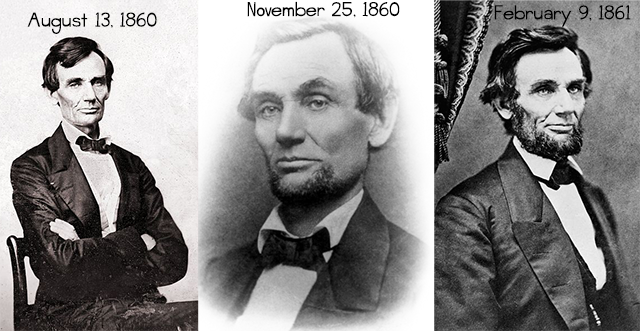
Given his attitude about his appearance, it’s perhaps not surprising that despite not definitively saying he would grow a beard, after replying to “little Miss” on October 19, 1860, Lincoln’s facial hair situation went like this (personally, I think he should have stopped at the middle one):

lincolns-beard

But this isn’t the end of the story. On Lincoln’s trip from Illinois to Washington D.C., the now President-elect made a stop in Westfield, New York on February 19, 1861.
On the train platform, he related the story behind his decision to grow a beard and asked if the little girl in question was in the crowd. She was and approached; at which point, according to Bedell, he said:
‘Gracie, look at my whiskers. I have been growing them for you.’ Then he kissed me. I never saw him again.
If you liked this article, you might also enjoy:
Bonus Facts:

  • Abraham Lincoln married Mary Todd, at the Edward’s home (her sister’s place) in Springfield, Illinois. Nicknamed Molly, Mary Todd first met Lincoln in 1840 when she was 21 and he was 31. Her family wasn’t too happy about the relationship because of Lincoln’s poverty & lack of political prospects. Nevertheless, she accepted his proposal and they were engaged. In 1841, they broke off the engagement and were separated for a while, till the fall of 1842. It was then, with the help of mutual friends (Mr. and Mrs. Simeon Francis), that the couple reunited and wasted no time in getting married (married after just 1 day back together, in fact).  Some speculate the rush was because Todd was pregnant with their future child Robert Todd Lincoln, or that Todd had seduced Lincoln into having sex with her, then forced him to marry her the next day.  There is no direct evidence of this, but Lincoln’s best man stated on Lincoln’s wedding day, he “looked like a man going to the slaughter” and it was reported that he also referred to his bride to be as “the devil” on the way to his wedding.  Their marriage was rocky right from the start and never seemed to get better.  Once, after a man sought retribution with Lincoln over his wife’s behavior (including beating the man with a broom), Lincoln said to him “Taggart, I’ve been putting up with her for the past 15 years, can you not put up with her for just 5 minutes for our friendship’s sake?”
  • Shortly before Lincoln decided to grow a beard, something of a beard revolution swept the United States and by the mid-19th century the formerly predominately clean-shaven men of America now nearly universally were sporting beards. In fact, one reporter, doing a story on the new trend in 1857, walked the streets of Boston and after counting 543 men that walked by him, found that 62% of them were now sporting bushy beards and all but 4 of the rest had some other type of significant facial hair. Even those four that lacked any significant facial hair sported what would later be called Side Burns, after General Ambrose Burnside.
  • The clean shaven look that Lincoln at the time was still clinging too, was essentially out of style. Needless to say, had Lincoln been running today, his campaign manager, rather than a little girl, would have told him he needed to grow some facial hair with most of the voting populace sporting it- particularly because at the time facial hair in America began being associated with radicalism; the Republican party was that.
  • John C. Frémont was the first candidate for the American Presidency to sport a beard when he ran in 1856.
  • After Lincoln, every elected President except William McKinley would sport facial hair. This trend finally ended when Woodrow Wilson took office in 1913.  From then on, U.S. Presidents have remained clean shaven.
  • During the Civil War, Bedell, now aged 15 in 1864, wrote another letter to Lincoln, only very recently discovered in 2007. This time, she was asking if Lincoln could help her find work as her father had recently lost “nearly all his property” and she wanted to help support her family, though her parents hadn’t asked her too. There is no record of whether Lincoln replied or ever even saw the letter.
  • As for what happened to Bedell, she went on to marry a Civil War veteran by the name of George Billings sometime around 1870 and took up work first farming, and then later George switched to banking. She lived to the ripe old age of 87 years old, dying in 1936.

Abraham Lincoln Established the Secret Service on the Day He was Shot by John Wilkes Booth


 Abraham Lincoln established the Secret Service on the day he was shot by John Wilkes Booth.
Unfortunately, even had the organization been instituted earlier, it wouldn’t have helped.  The Secret Service in the beginning had no part in protecting the President, but rather were tasked with cutting down on the amazing amount of counterfeit money circulated in the United States at the time (hence why until March of 2003 they were a branch of the U.S. Department of the Treasury).  It is estimated that about 1/3 of the U.S. currency in circulation was counterfeit when Lincoln signed the piece of legislature that would establish the Secret Service.
Lincoln did technically have a permanent assigned guard on the night of his murder, but a more inept guard they could not have found for the President.  The man was  policeman, John Parker.  How did Parker get such an illustrious job as one of the four hand-picked to guard President Lincoln?  It’s a mystery.  As a policeman, Parker frequently found himself in front of police boards for such things as being drunk on duty, sleeping on the job, frequenting brothels on the job, and a myriad of other charges that basically all came down to “conduct unbecoming an officer”.
Despite this, Parker managed to get off each time he went before the boards.  For the “sleeping on the job” charge, he supposedly claimed that he was performing his duties patrolling his area when he heard several ducks quacking on top of a trolley car.  Naturally, he climbed up top to see what was going on… and promptly fell asleep.
As for frequently visiting brothels while on duty, he supposedly defended himself by claiming that he was not actually there as a customer, but rather to visit certain of the ladies privately as they had called for a police officer; so it was naturally his job to go hear what they had to say and, of course, they wanted to talk to him privately…
Through all this, not only did he manage to keep his job, but when the death threats against President Lincoln became severe enough, Parker was selected with three others to be the President’s guard.  It is theorized by some that this was because he may have been related to Lincoln’s wife, Mary Todd Lincoln, through her mother’s family.  Mrs. Lincoln is known to have written a letter on Parker’s behalf to get him out of the draft, so at least there was some association there, whether family or not.
Unfortunately for the President, on the night he was assassinated, it was Parker’s shift, and not one of the other three who had outstanding records as policemen.
So where was John Parker when President Lincoln was being shot in the head? No one is quite sure.  He did in fact start off the evening guarding the President as he was supposed to.  But as he couldn’t see the play from his guard position, he left to find a better location with which to watch.
During intermission, he is known to have left with the President’s coachman to go to the Star Saloon for some drinks.  Incidentally, some accounts claim around that same time John Wilkes Booth could also be found drinking at the Star Saloon.
After this, no one is quite sure where Parker was when he was supposed to be guarding the President.  The important part is that he was not at his guard post.  This may or may not have mattered though.  Even had Parker been there, he very likely would have let Booth in to see the President, as Booth was a famous actor at the time and Lincoln had even been at Ford’s Theater to see one of Booth’s plays in 1863.  That being said, Booth would have likely been announced in that case, perhaps making it more difficult for him to deliver a fatal shot.
As fellow Presidential guard William H. Cook stated, “Had [Parker] done his duty, I believe President Lincoln would not have been murdered by Booth… Parker knew that he had failed in duty. He looked like a convicted criminal the next day.”
Even without Parker there, Lincoln also may have survived the ordeal had his son, Robert Lincoln, chosen to accept his father’s invitation to the play, instead of going to meet his friend John Hay, who was the President’s private secretary.  Being the youngest of that party, Robert Lincoln would have sat in the back seat directly next to the door.  Given Booth was using a Derringer, he would have had to get close to the President for an accurate shot, thus would have had to walk past Robert Lincoln, which would have made it so Booth would not have been able to sneak up on the President.
As with the case of Booth being announced had Parker been there, who knows what would have happened if Robert Lincoln had decided to attend? But it’s not farfetched to think the President would have had a much better chance had he been aware of Booth’s presence.  At the least, it likely would not have been a head shot as Derringers were notoriously inaccurate unless at extremely close range, so Booth would have probably aimed for the abdomen if he hadn’t been able to get directly behind the President.  But who knows?  Maybe he would have gone in close for a handshake and got off the shot at close range anyways.
As to Parker’s excuse for not being at his post, according to Lincoln’s dressmaker, Elizabeth Keckley, Parker had this to say to Mary Todd Lincoln after she accused him of murdering her husband:
I could never stoop to murder, much less to the murder of so good and great a man as the President. I did wrong, I admit, and have bitterly repented. I did not believe anyone would try to kill so good a man in such a public place, and the belief made me careless.
Now you might think that Parker would finally see some real consequences for his dereliction of duty with this one.  I mean, he was the President’s guard and wasn’t at his post and possibly partially drunk at the time of the assassination.  But, no… the charges against Parker were dismissed, though he was tried. (The transcript of that event has unfortunately been lost).  In addition, the fact that Parker had been away from his post at the time of the murder was not mentioned in the official report on the Lincoln Assassination nor was it mentioned in major news reports of the day, so Parker avoided the public’s wrath too.
Not only this, but Parker managed to keep his job, though at least now not guarding a President directly.  His new position was as White House security, including being assigned to protect Lincoln’s widowed wife.
So did Parker learn his lesson after such a dramatic occurrence?  Nope.  After three more years of spotty service, he was finally fired on August 13, 1868 for sleeping on the job.  Ironically, Parker and his family are buried in a cemetery that borders Lincoln Road (Glenwood Cemetery).
If you liked this article and the Bonus Facts below, you might also like:
Bonus Facts:

  • While you’d have thought Lincoln’s assassination would have shown the need for better protection for the President, this didn’t happen until after President Garfield and President McKinley were assassinated in 1881 and 1901 respectively.  After the McKinley assassination, it was ultimately decided that the Secret Service should take over the responsibility of guarding the President, starting with Theodore Roosevelt.  This may seem like a strange choice, to assign the Treasury Department’s police force to this task, but at the time, they were the only Federal law enforcement agency with enough man-power to take on this job and others given to the Secret Service (many of those jobs later went to the FBI, CIA, etc.).
  • Lincoln’s was not initially meant to be the only assassination on the night Booth murdered him.  Lewis Powell, David Herold, and George Atzerodt were also to kill strategic targets at the same time, with the hope of destabilizing the government.  Powell and Herold were to kill Secretary of State William H. Seward.  Atzerodt was to kill Vice President Andrew Johnson.  Powell almost managed to assassinate Seward, who was already bedridden at the time.  But he was intercepted before getting to the bedside of Seward and in a subsequent scuffle his gun misfired and it became useless.  He then switched to using a knife, but was only able to wound Seward before a scuffle with others in the house resulted in him having to flee.  Atzerodt simply lost his courage for the thing and went out and got drunk instead.  Atzerodt had initially only signed on to the ordeal when it was planned to simply kidnap the targets.  Once the plan changed to murder, he lost his enthusiasm.
  • It’s actually kind of a wonder that Lincoln wasn’t assassinated before he was.  Despite the numerous death threats he received and a near miss in 1864, he frequently walked around, rode horseback, took in plays, went to church, etc. without any guard whatsoever.  Whenever possible, he avoided bringing his assigned police guard or, before that, occasional military escort as he disliked having an escort.
  • Though commissioned on April 14th, 1865, it wouldn’t be until July 5, 1865 that the Secret Service officially got to work.
  • While the Secret Service is authorized to protect a variety of people, such as visiting heads of state, presidential candidates, the President, Vice President, their respective immediate families, etc., all of these can decline the Secret Service’s protection except for the President, Vice President, President-elect, and Vice President-elect.  Also the person next in line for the Presidency if something happens to the President or VP also cannot refuse protection until once again there is a sitting President and Vice President.
  • While Secret Service Agents protecting the President are often depicted in movies always wearing suits, in fact the non-uniform division will dress to blend into their surroundings.  So if they are at a beach, they’ll likely be wearing shorts and a t-shirt, depending on what is appropriate.  The fact that the President is generally shown at suit and tie type events, means that the Secret Service are also generally seen that way as they dress to match.  But these Secret Service agents protecting the President directly don’t have a specific uniform (though others do).
  • The first Secret Service Agent to die in the line of duty was William Craig.  He died when a Trolley car struck President Roosevelt’s horse carriage.  Roosevelt was not seriously injured, but Craig was killed.
  • The only member of the Secret Service to be killed while protecting a President (in this case President Harry Truman) was Leslie Coffelt.  Not only did he die protecting the President, but after being shot three times in his chest and abdomen, he managed to get off a single shot at one of the would be assassins, Griselio Torresola.  He made that shot count, hitting Torresola in the head, killing him.  The other would-be assassin, Oscar Collazo was shot by two White House policemen during the same altercation.  He recovered, but had to serve 29 years in prison before being let out.
  • Special Agent Tim McCarthy nearly became the second to be killed protecting a President when he put himself in between a would-be assassin and Ronald Reagan on March 30, 1981.  For his efforts, he got a bullet to his abdomen, which could have been worse as a total of six shots were fired at Reagan. McCarthy recovered from the incident with no ill effects.
  • During the Kennedy assassination, Agent Clint Hill jumped from the running board of his car (directly behind the President’s, both of which were in motion) to the President’s car and used his body as a shield for the President and his wife.  Of course, the damage was already done as far as President Kennedy’s fate went.
  • Agent Rufus Youngblood, riding with the Vice President during the Kennedy assassination, similarly jumped into the front seat to protect Vice President Johnson.
  • While for a long time lifetime protection was offered to all Presidents and Vice Presidents and their immediate families, that is no longer the case.  For all Presidents after January 1, 1997, protection will only be offered for 10 years after leaving office.  This change was put down as part of the Treasury Department Appropriations Act of 1995.  Anyone who was President before that date still will receive lifetime protection.
  • Today the Secret Service has two primary jobs.  First, protection of the President, Vice President, and other dignitaries.  Second, financial fraud investigations of varying sorts.  They are also now a branch of the U.S. Department of Homeland Security.
  • General George Washington was given a “Commander-in-Chief” Guard during the American Revolution, but this was disbanded in 1783.

14 Interesting Facts You Probably Didn’t Know About The Terminator

TRANSCRIPT
Released in 1985 on a relatively shoe-string budget of around $6.5 million, The Terminator is a bona fide cinema classic, but few are aware of how close this Sci-Fi cornerstone came to never being made . Today we’ll be covering this and many other interesting Terminator Facts.
1) To begin with, according to James Cameron, the idea for the Terminator came to him in a nightmare while he was directing the little known budget horror movie Piranha II: The Spawning. In the nightmare, Cameron claims he was chased by a mechanical skeleton, the image of which became the basis for the T-800 and the plot.
2) Speaking of the plot, it’s worth noting that it bears some resemblance to an episode of Outer Limits written by acclaimed Sci-Fi writer, Harlan Ellison called Soldier. The episode revolves around a soldier who is sent back in time. Ellison claimed the movie had unfairly lifted from this story, which itself was based on a short story he wrote called “Soldier from tomorrow”, without proper credit. In the end, in exchange for an undisclosed sum and accreditation on later versions of the film, the problem went away for the studio. How much money changed hands isn’t known as a gag order was placed on the case. To this day, Cameron is still reportedly bitter about the settlement and had attempted to get the studio not to settle.
3) Although several studios were interested in Cameron’s initial script, they were hesitant to let the young, as of yet, unproven director helm the project, so passed on it. Cameron was also representing himself, as he’d recently fired his agent for telling him he needed to scrap the Terminator project and work on something better. To ensure that he would be able to direct the movie, Cameron ultimately sold the rights to the script for a single dollar to producer Gale Hurd with the proviso that if she wanted to make it into a film, he had to be brought on to direct. One year after the release of Terminator, Cameron and Hurd got married, though divorced after just four years in 1989.
4) In an effort to secure financial backing for the film, James Cameron had his good friend Lance Henriksen (best known for portraying Bishop in the Aliens franchise) turn up 15 minutes early to a meeting he had arranged with John Daly from Hemdale Pictures dressed as the Terminator. Henriksen swaggered into Daly’s office wearing a leather jacket with cuts across his face and gold foil from a cigarette packet stuck to his teeth and sat down in the chair opposite Daly without moving or saying a word. A bit of agonizing silence ensued before Cameron ran into the room and pitched his idea of a robot assassin from the future. It must have worked because Daly ultimately agreed to partially back the film, along with HBO and Orion, at a budget of about $4 million which was later raised to $6.5 million.
As to why Cameron chose Henriksen for this, Henriksen was actually Cameron’s first choice to play the Terminator, with his likeness being used for much of the film’s early concept art. Cameron initially planned for the Terminator to look like an ordinary man; his thinking was that the Terminator would be scarier if it could potentially be anyone in a crowd. This idea fell to the wayside when Schwarzenegger was cast, but would ultimately wind up being the basis for the shapeshifting T-1000 in Terminator 2.
5) The studio decided against hiring Henriksen to play the Terminator as one of their conditions for backing the film was that it needed a big star in one of the title roles. Orion bigwig, Mike Medavoy infamously gave Cameron the suggestion of hiring O.J Simpson to play the Terminator and Arnold Schwarzenegger to play Kyle Reese. Cameron didn’t like the idea of hiring Simpson because he didn’t believe the NFL star turned actor would make a believable killer and because the idea of making a film featuring, as he said, “an African-American man chasing around a white girl” felt wrong to him.
Cameron was similarly hesitant to hire Schwarzenegger to play the film’s hero because at 6 feet 2 inches tall with the body of a Greek god, there were few actors in Hollywood Schwarzenegger wouldn’t tower over. Cameron actually planned to turn Schwarzenegger off the role by intentionally antagonising him over dinner and then going back to the studio to claim they’d clashed over “creative differences”. According to Cameron, the last thing he said to his roommate before leaving for lunch that day was “Do I owe you any money? Because I have to go pick a fight with Conan.”
Cameron’s opinion on Schwarzenegger softened considerably over the course of their first meeting when the actor explained to Cameron how he felt a Terminator should act. To quote: “When he loads a new magazine into his gun, he won’t have to look because a machine will be doing it, a computer. When he kills, there will be absolutely no expression on the face, not joy, not victory, not anything”
Cameron was so impressed by this succinct and nuanced take on the character that he offered Schwarzenegger the role. When offered the part, Schwarzenegger was hesitant to accept it, believing that it would be a step backwards for him to play an almost silent villain after being the hero of Conan the Barbarian. He ultimately decided that the movie would be small enough that playing such a role wouldn’t later negatively impact his ability to get larger speaking roles. Cameron, in an effort to sway the actor, used his skills as an artist to paint a picture of Schwarzenegger as the Terminator and sent it to him. Arnold later stated that upon seeing the picture, he stopped and said to himself “I am the Terminator”.
6) After agreeing to play the Terminator, Schwarzenegger spent several weeks shooting guns with both hands so that he could do so without blinking or flinching and appear ambidextrous. He also spent many hours prior to the shooting of the film practicing taking apart and putting back together various guns until he could do it blindfolded. With all of this, Schwarzenegger was simply trying to minimise any and all unnecessary movement while playing the Terminator. This efficiency of movement also included scenes where he wasn’t using weapons. A good example of this can be seen when the Terminator searches for Sarah Connor in the parking lot; if you rewatch that scene, you’ll notice that Schwarzenegger moves his eyes before moving his head.
7) To make the Terminator seem more unsettling, Schwarzenegger refrained from blinking wherever possible and spent the majority of the film with his skin covered in a thin layer of Vaseline so that his face had a perpetually waxy appearance. This was to make it so that there was always something slightly off about the Terminator’s appearance that you just couldn’t quite put your finger on.
8) Michel Beihn, who played Kyle Reese, almost didn’t get the role because he accidentally auditioned with a southern accent, which the studio wasn’t too keen on since they didn’t want the character to be from any specific place. As it turns out, Beihn had just been at a reading for Cat on a Hot Tin Roof and forgot to speak in his regular voice. He had to audition again after realising his mistake.
9) Something that wasn’t in the original script was the relationship between Sarah Connor and Kyle Reese. This aspect was actually added after it was suggested by HBO, who partially funded the movie.
One suggestion that wasn’t taken was from an unnamed executive who reportedly felt quite strongly that Kyle Reese should have a robot dog.
10) The iconic laser mounted pistol used by the Terminator in several key scenes was created by a guy named Ed Reynolds working for a company that specialised in tactical flashlights now known as SureFire. Since diode lasers were still a fairly new technology at that point Reynolds had to use a helium-neon laser in the heavily modified .45 Longslide gun; this laser required significant power, resulting in a hidden power pack and a wire running inside Schwarzenegger’s sleeve from the power supply to the gun. For the considerable amount of work and money Reynolds put into the laser sighted gun, the prop company sent him a t-shirt and a poster as his only compensation. Arnold Schwarzenegger also later sent Reynolds an autographed poster after he learned of how little he was given for creating such an iconic part of the franchise.
11) This was by no means the only thing done to try and stretch the film’s budget as far as possible. For example, to save a bit of money, Cameron filmed several scenes without a permit, the most notable probably being the scene in which the Terminator punches in a car window and steals it. According to Schwarzenegger he was driven to the location by Cameron who told him to walk up to the car and punch its window. Cameron filmed the scene himself.
12) Although the film is regarded as a classic today, Orion executives reportedly hated it and had so little faith in the film that they refused to even screen it for critics. According to Linda Hamilton, interest in the film was so non-existent that she was uninvited from the pre-release press tour because nobody wanted to interview her. This lack of support left a bad taste in James Cameron’s mouth and afterwards he was decidedly critical of Orion, especially how quick Mike Medavoy was to take credit for the film’s success after refusing to support it with advertising.
13) The most famous line from the film, “I’ll be back,” almost never was. Schwarzenegger stated he had trouble saying “I’ll” and tried to convince Cameron to change the line to “I will be back” by reasoning that a robot would not use contractions. Cameron didn’t agree.
14) In Poland, The Terminator was re-named, The Electronic Murderer. You see, in Polish “terminator” more or less means “an apprentice”.
Bonus Facts:

  • While Arnold Schwarzenegger is best known for his acting and his work while Governor of California, he was actually remarkably successful even before any of that.  Before he was thirty, he’d already served in the army, won numerous body building competitions, while simultaneously going to business school and working at a health club. Once he immigrated to America, he continued to compete in bodybuilding competitions while also starting a bricklaying business, which he then used the profits from to start a mail-order business selling fitness related products like workout instructional materials. He then used the profits from that and his winnings in body building competitions to start a real estate investing business, ultimately making him a millionaire in his 20s, long before his breakout role at the age of 35 in the 1982 Conan the Barbarian
  • As for another famed physical specimen, who perhaps isn’t given enough credit for his brains, in 2009, a team of armed robbers broke into Dolph Lundgren’s home in Spain, tied up his wife, jewellery designer Anette Lundgren, who was home alone, and began stealing her jewellery and other expensive items in the house. Once they saw a family photo with Lundgren in it, however, they literally dropped everything and fled. They were probably aware that, “Whatever he hits, he destroys.” In truth, the 6 ft. 5 in. Lundgren was an elite ranger in the Swedish military and has a 3rd degree black belt in Kyokushin karate. Beyond his more obvious physical attributes, he has a Master’s degree in chemical engineering, and speaks 5 languages.
  • Interestingly, Arnold Schwarzenegger was offered the lead role in what would become the movie Die Hard. Even more interesting than that, originally the role had been offered to a 73 year old Frank Sinatra, as Die Hard was technically a sequel to a 1966 film, The Detective, starring Frank Sinatra, based on a book of the same name. The sequel to the book was Nothing Lasts Forever, which inspired Die Hard. So, contractually, the role had to be offered to Sinatra. Of course, the aging star turned it down. Schwarzenegger was then offered the role. He turned it down and the role was then offered to Bruce Willis and the lead characters name was changed to John McClane instead of Joe Leland, as had been the name in The Detective. At this point, Willis was actually known more for comedy, not action, so the studio was less than thrilled with having to go with him initially. But as the movie grossed $140 million (about $268 million today) off a budget of just $28 million, and is still considered something of a classic as well as established one of the most successful movie franchises of all time, they got over it.
  • One of Linda Hamilton’s first lead roles was in Stephen King’s The Children of the Corn, which was filmed just before The Terminator. A little known fact about The Children of the Corn is that the story was original published in the March of 1977 edition of Penthouse Magazine. While King had been able to quit his day job as a high school English teacher after the success of the 1973, Carrie, he still occasionally published short stories in such magazines as Penthouse. He later bundled up many of these short stories into the book Night Shift, which would go on to win the Balrog Award for Best Collection, as well as be nominated for the World Fantasy Award and the Locus Award.  It also spawned numerous film and TV adaptations of the stories including The Lawnmower Man, Graveyard Shift, Cat’s Eye (which incidentally starred 10 year old Drew Barrymore), The Mangler, and Sometimes They Come Back.
  • James Cameron and Linda Hamilton got married in 1997, but divorced just two years later. According to Hamilton, she felt that “Titanic was the mistress he left her for” and despite rumors of Cameron cheating on her with his eventual fifth wife Suzy Amis, Hamilton has always maintained that Cameron is rather a “serial monogamist”.
  • Linda Hamilton has an identical twin sister who appeared in Terminator 2: Judgement Day as Linda’s double in a scene where the T-1000 is impersonating her character.